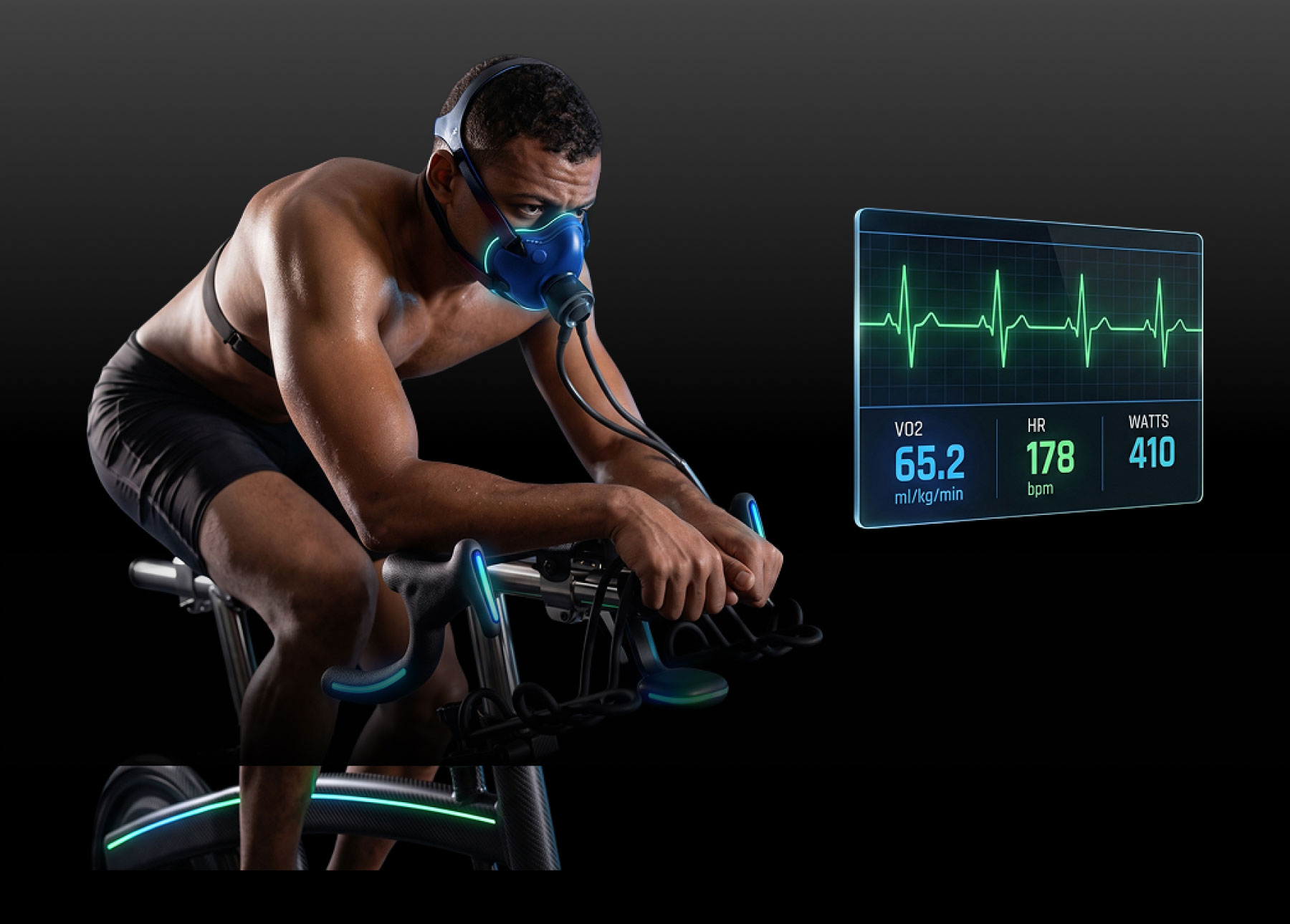
VO₂ Max (maximal oxygen uptake) measures how efficiently your body uses oxygen during exercise. It reflects the integrated performance of your heart, lungs, blood vessels, and muscles.
In simple terms: VO₂ Max tells us how well your body produces energy.
And in longevity medicine, energy production = life capacity.
VO₂ Max is not just a fitness metric — it is one of the strongest predictors of long-term health and survival.
• Higher VO₂ Max is directly associated with lower risk of death from all causes
• Individuals with the highest fitness levels have the lowest mortality risk — without an upper limit of benefit
• Even small improvements can significantly impact outcomes, with each increase in fitness linked to meaningful reductions in mortality risk
In fact, low cardiorespiratory fitness has been shown to be as dangerous — or even more dangerous — than traditional risk factors like smoking, diabetes, or cardiovascular disease.
Patients with higher VO₂ Max levels consistently demonstrate:
• Lower rates of heart disease, stroke, and metabolic dysfunction
• Reduced risk of cancer, dementia, and chronic illness
• Improved insulin sensitivity and inflammation profiles
• Greater functional independence with aging
Even more compelling: fitness level often matters more than weight. A person with high VO₂ Max and higher body weight may have better survival outcomes than a lean individual with low fitness.
VO₂ Max behaves like a true longevity biomarker:
• Every increase — even modest — moves the needle
• There is a stepwise reduction in mortality risk as fitness improves
• There is no clear ceiling where benefits stop
One study demonstrated that improving fitness by just 1 metabolic equivalent (MET) can improve survival by 10–25%.
Absolutely — and this is where longevity medicine becomes actionable.
VO₂ Max is highly trainable at any age.
The most effective strategies include:
1. High-Intensity Interval Training (HIIT)
• Short bursts of near-max effort
• Proven to significantly increase VO₂ Max
• 1–2 sessions per week
2. Zone 2 Training (Foundation)
• Moderate intensity, sustainable pace
• Builds mitochondrial efficiency
• 2–4 sessions per week
3. Strength Training
• Supports metabolic health and muscle efficiency
• Enhances overall oxygen utilization
4. Consistency Over Intensity
• Long-term adherence matters more than perfection
• Even low doses of higher intensity can drive improvements
In a modern longevity clinic, VO₂ Max serves as:
• A baseline marker of physiologic reserve
• A target for intervention
• A longitudinal measure of aging trajectory
Unlike many biomarkers, this is one you can actively improve — and see measurable results over time.
If your goal is not just to live longer — but to live stronger, sharper, and more independent — VO₂ Max should be a priority.
Your VO₂ Max today is one of the clearest predictors of your quality of life tomorrow.
1. Mandsager et al., 2018 — JAMA Network Open. Large cohort study (122,000+ patients). Found cardiorespiratory fitness is inversely associated with mortality with no upper limit of benefit.
2. Strasser et al., 2018 — Progress in Cardiovascular Diseases. Identified VO₂ Max as a strong independent predictor of all-cause and disease-specific mortality.
3. Scribbans et al., 2016 — Systematic Review & Meta-analysis. Demonstrated that increasing VO₂ Max significantly improves survival. Even small increases produce meaningful reductions in mortality risk.
Most people encounter VO₂ Max as an estimate on a smartwatch. That’s a start. But an estimate is not a measurement, and a number without context is not a strategy.
At Senolytix, VO₂ Max is one of the most important metrics in our longevity framework. We test it. We track it over time. And we build protocols specifically designed to improve it — because the research is unambiguous: cardiorespiratory fitness is one of the strongest modifiable predictors of how long and how well you live.
• Formal VO₂ Max testing. We measure your actual cardiorespiratory capacity — not a wristwatch estimate — giving us a precise baseline and a clear target for improvement.
• Structured training prescriptions. We design exercise protocols that combine Zone 2 conditioning, HIIT, and resistance training in the right ratios for your fitness level, recovery capacity, and goals — calibrated to move your VO₂ Max efficiently.
• Integrated with metabolic and hormonal data. VO₂ Max doesn’t exist in isolation. We interpret it alongside your metabolic panel, inflammatory markers, hormone levels, body composition, and HRV to understand the full picture of your physiologic capacity.
• Longitudinal tracking. We retest over time to measure progress, adjust protocols, and ensure your cardiovascular fitness is improving alongside every other pillar of your longevity plan.
• Recovery and adaptation support. For patients who need it, peptide therapy, hormone optimization, and sleep strategy help remove the barriers that prevent VO₂ Max from improving — because fitness gains depend on recovery as much as effort.
This is the difference between knowing your VO₂ Max and actually improving it. Between a number on a screen and a clinically managed trajectory toward better performance and longer healthspan.
WHY SENOLYTIX?
We don’t estimate your fitness. We measure it, manage it, and improve it.
VO₂ Max is the single strongest predictor of all-cause mortality that you can actually change. At Senolytix, we treat it with the clinical seriousness it deserves — testing it formally, integrating it with your full diagnostic profile, designing training protocols around it, and tracking your improvement over time. When combined with hormone optimization, metabolic strategy, body composition tracking, and recovery support, VO₂ Max becomes more than a metric. It becomes a measurable path to a longer, stronger life.
This is longevity medicine where your fitness is as rigorously managed as your bloodwork.
At Senolytix, cardiorespiratory fitness is a cornerstone of our longevity model — and we continue to sharpen how we use it. Current areas of focus include:
• Refining individualized training protocols that balance VO₂ Max improvement with muscle preservation, joint health, and recovery — especially for patients over 50
• Correlating VO₂ Max trends with biological age testing, inflammatory panels, and hormonal data to build a more complete picture of physiologic aging
• Integrating VO₂ Max and HRV data together to optimize the balance between training stimulus and recovery capacity in real time
• Exploring how interventions like peptide therapy and therapeutic apheresis may support the cardiovascular and mitochondrial adaptations that drive VO₂ Max improvement
Fitness is one of the few longevity variables where effort translates directly into measurable years. We’re committed to helping you earn them. Expect more in future newsletters.
Ready to Know — and Improve — Your Number?
If you want to move beyond estimates and build a real, clinically managed plan to improve your cardiorespiratory fitness, metabolic health, and long-term performance, we’d welcome the conversation.
.svg)


.svg)
.svg)

.svg)
